Lesson 12·C Programming
Pointers in C
Direct memory addressing, dereferencing, and pointer variables
What is a Pointer?
A Pointer is a special variable that stores the direct memory address of another variable. In C, pointers are designated using the asterisk (*) symbol.
Pointers are derived data types that provide low-level access to memory, allowing efficient array manipulation, dynamic memory allocation, and pass-by-reference semantics.
Memory Address Illustration
Consider the declaration int *ptr; int tot = 95; ptr = &tot;
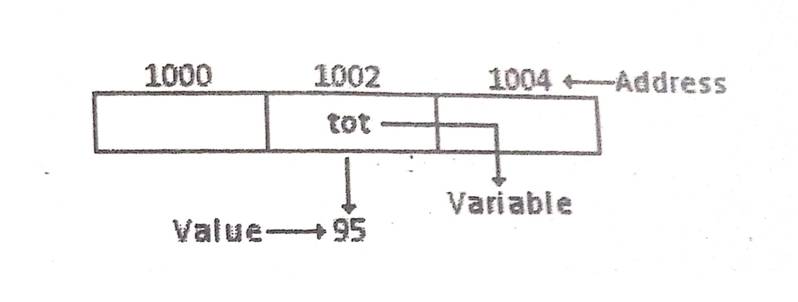
Features & Capabilities of Pointers
- A pointer variable must always be declared with the * prefix.
- Pointers must point to matching data types (mixing types requires explicit casting).
- Pointers provide the most efficient method for traversing and processing arrays and strings.
- Enables functions to return multiple values or mutate caller data using addresses.
- Essential for dynamic memory allocation using malloc(), calloc(), realloc(), and free().
- Reduces program overhead and improves execution performance significantly.
Practical Pointer Example
Demonstrating the address-of operator (&) and dereference operator (*):
C Example
#include <stdio.h>

void main() {
    int a = 10;
    int *ptr;

    ptr = &a;  // ptr holds the memory address of variable a

    printf("Value of a: %d\n", a);
    printf("Value at *ptr: %d\n", *ptr);
    printf("Address stored in ptr: %p\n", (void*)ptr);
}
Program Output
Value of a: 10
Value at *ptr: 10
Address stored in ptr: 0x7ffd5b92e84c
Note
Using *ptr reads or modifies the value stored at the referenced memory address (dereferencing).